
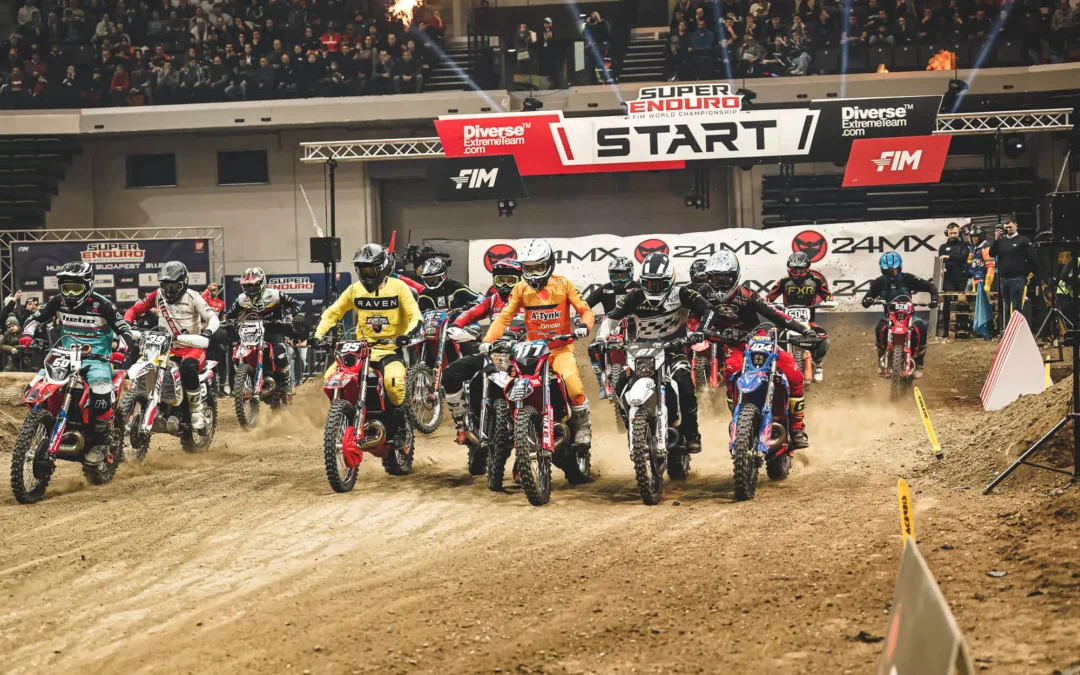
Huge rocks, logs, tyres, water, mud and thousands of spectators packed into an arena. Today, it seems perfectly natural to see the world’s best enduro riders competing indoors, but SuperEnduro did not emerge overnight. The history of the sport can be traced back to Barcelona, where, at the turn of the millennium, a completely new idea gave birth to a racing format that would become an official FIM World Championship just a few years later.
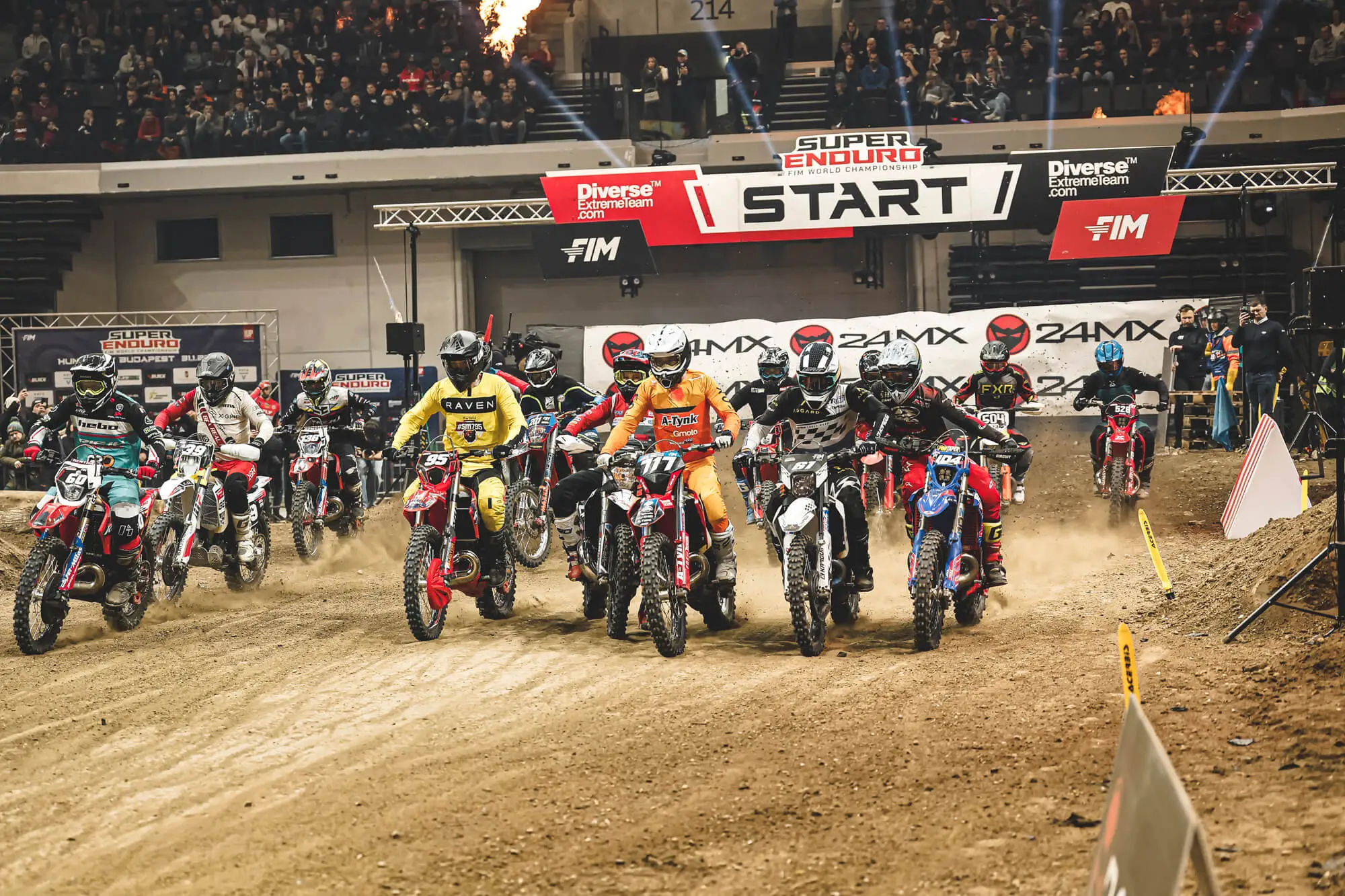
A unique idea in Barcelona
To find the true birthplace of SuperEnduro, we have to go all the way back to 2000.
The story began in Barcelona, where the Enduro Indoor de Barcelona was created alongside Indoor Trial. The idea came from RPM Racing, the same promoter responsible for Barcelona’s indoor trial event. The first race was held at the Palau Sant Jordi in February 2000 and was originally intended as a supporting event for the trial competition.
The concept was simple yet revolutionary: take the most difficult and technical elements of enduro and bring them inside an arena.
The result was a course combining rocks, logs, various obstacles and other artificially created technical sections. The aim was not only to provide a serious challenge for the riders, but also to create racing that was spectacular and easy for spectators to follow.
The response exceeded all expectations. More than 10,000 spectators attended the first Barcelona event, leading to a second edition being organised later that same year.
And with that, something new had begun.
Why was indoor enduro needed in the first place?
Traditional enduro racing takes place in a completely different environment. Riders compete over long sections of natural terrain, often through forests, mountains and constantly changing surfaces. In motorsport terms, it can roughly be compared to rallying.
It is an incredible challenge for the competitors, but for spectators, much of the action is simply out of sight. From any one location, fans might only be able to see one or two corners or obstacles along an entire section.
One of SuperEnduro’s most important innovations was therefore to compress some of enduro’s toughest obstacles into a single compact course.
The result sits somewhere between supercross, trial and enduro. From supercross came the stadium environment, the spectacle and the racing intensity; from enduro came the terrain and endurance; and from trial came the highly technical obstacles, some of which riders have to negotiate at almost unbelievably low speeds.
2007: the first official world series is born
Following the success of the Barcelona event and similar indoor competitions, the discipline began attracting increasing attention. The breakthrough came in 2007.
That year, the Fédération Internationale de Motocyclisme (FIM) established the FIM Indoor Enduro World Cup, the first official FIM series for indoor enduro. Its inaugural season was held in 2007/2008.
The opening round took place in Barcelona, but this was no longer simply an exhibition event: the world’s best enduro riders were now competing for World Cup points.
The field included names such as David Knight, Mika Ahola, Xavi Galindo and Tadeusz Błażusiak.
The first official FIM Indoor Enduro World Cup season ultimately ended with victory for David Knight, who made history as the series’ first champion.
It wasn’t called SuperEnduro yet
Interestingly, nobody was talking about a SuperEnduro World Championship at that point.
The series was originally called the FIM Indoor Enduro World Cup. In 2010/2011, it was renamed the FIM Indoor Enduro World Championship, before receiving the name we know today for the 2011/2012 season: the FIM SuperEnduro World Championship.
So when we talk about the SuperEnduro World Championship today, we are actually talking about a series whose roots stretch back more than two decades.
It didn’t stay in Europe
The series initially focused mainly on European venues, but over time it expanded into more and more countries.
By the 2013/2014 season, for example, Brazil and Mexico had joined the calendar, making SuperEnduro a truly international series.
The basic concept of the races, however, remained unchanged: the world’s best enduro riders battling head-to-head on a short, extremely technical course built inside a stadium.
What makes it so difficult?
One of the defining characteristics of SuperEnduro is the sheer variety of challenges riders face within a single lap.
A course can feature enormous rocks, logs and tyres, among many other obstacles.
And this is where one of the most important aspects of the sport comes into play: the winner is not necessarily the rider who is fastest over every individual obstacle, but the one who adapts to them most effectively.
One wrong move on the rocks, a poor line or getting stuck on an obstacle can completely change the running order within seconds.
Under FIM regulations, a SuperEnduro course must be at least 300 metres long, with the best riders expected to complete a lap in roughly 45 seconds to one minute.
That gives a good indication of just how intense the racing is: almost anything can happen within the space of a single minute.
SuperEnduro is not the same as American EnduroCross
The United States also deserves a mention when discussing the history of SuperEnduro.
A similar racing format developed there in the form of EnduroCross, which also has its roots in indoor enduro. One of the key figures behind the American version was Eric Peronnard, who had previously been involved in organising events including Supercross Paris-Bercy and the US Open of Motocross.
The first EnduroCross event was held in Las Vegas, and the AMA EnduroCross Championship was established in 2007.
The two disciplines share many similarities, but the FIM SuperEnduro World Championship developed into its own independent world championship series.
From Barcelona to Budapest
One of the fascinating aspects of SuperEnduro’s history is how the sport has continuously expanded into new venues over the years.
Alongside Barcelona, cities such as Genoa, Łódź, Madrid, Riesa, Prague, Helsinki and Kraków became important stops on the calendar. Later, venues outside Europe also joined the championship.
Hungary eventually found its place on the SuperEnduro map as well, with the Budapest round steadily growing in popularity since 2019.
Today, the Hungarian round has become one of the country’s most distinctive winter motorsport events. It is a World Championship race where spectators are not watching distant sections of a circuit several kilometres long, but can instead see the world’s best riders from just a few metres away as they literally fight their way through the obstacles.
More than just a motorcycle race
Perhaps this is exactly what explains SuperEnduro’s success.
Unlike traditional enduro, it also features direct, head-to-head racing. The course is short, the riders remain in view almost constantly, the obstacles are spectacular, and mistakes are immediately visible.
At its core, the sport was born from a remarkably simple idea: take the hardest parts of enduro, build them into a course in the middle of a stadium, and unleash the world’s best riders on it.
The concept first tested in Barcelona in 2000 became an official FIM world series within seven years. In 2011, it also received the name that is now recognised around the world: SuperEnduro.
And perhaps that is the sport’s greatest distinguishing feature. While its roots remain firmly planted in the traditions of enduro, its courses and racing format constantly force riders to do something completely different from what they would face in a traditional enduro race.
It started as an experiment in Barcelona. Today, World Championship titles are decided on it.